Samuel Anoints Saul as King
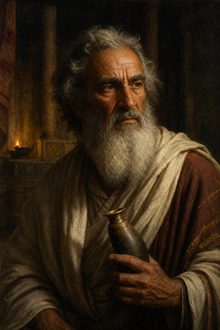
The elders come to Samuel at Ramah and ask for a king, to be like the other nations. Samuel takes it personally, and God tells him the rejection is not of Samuel but of God — then instructs him to warn them exactly what a king will cost. The speech is a catalogue of conscription and taxation: he will take your sons, your daughters, your fields, a tenth of everything, and you will cry out. The people say they want one anyway.
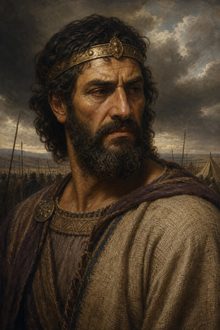
Saul enters the narrative looking for his father's lost donkeys. Tall, impressive and from the smallest tribe, he is anointed privately by Samuel, then chosen publicly by lot at Mizpah — and has to be fetched from where he is hiding among the baggage.
Some go home muttering. Saul lets it pass, and the monarchy begins on that ambiguous note.
Where in scripture
[1] When Samuel was old, he made his sons judges over Israel. [2] Now the name of his firstborn was Joel; and the name of his second, Abijah. They were judges in Beersheba. [3] His sons didn’t walk in his ways, but turned away after dishonest gain, took bribes, and perverted justice. [4] Then all the elders of Israel gathered themselves together and came to Samuel to Ramah. [5] They said to him, “Behold, you are old, and your sons don’t walk in your ways. Now make us a king to judge us like all the nations.” [6] But the thing displeased Samuel, when they said, “Give us a king to judge us.” Samuel prayed to Yahweh. [7] Yahweh said to Samuel, “Listen to the voice of the people in all that they tell you; for they have not rejected you, but they have rejected me as the king over them. …
1 Samuel 8:1–22 — opening verses
[1] Now there was a man of Benjamin, whose name was Kish, the son of Abiel, the son of Zeror, the son of Becorath, the son of Aphiah, the son of a Benjamite, a mighty man of valor. [2] He had a son, whose name was Saul, an impressive young man; and there was not among the children of Israel a better person than he. From his shoulders and upward he was taller than any of the people. [3] The donkeys of Kish, Saul’s father, were lost. Kish said to Saul his son, “Take now one of the servants with you, and arise, go look for the donkeys.” …
1 Samuel 9:1–27 — opening verses
[1] Then Samuel took the vial of oil, and poured it on his head, and kissed him, and said, “Hasn’t Yahweh anointed you to be prince over his inheritance? [2] When you have departed from me today, then you will find two men by Rachel’s tomb, on the border of Benjamin at Zelzah. They will tell you, ‘The donkeys which you went to look for have been found; and behold, your father has stopped caring about the donkeys, and is anxious for you, saying, “What shall I do for my son?”’ [3] “Then you will go on forward from there, and you will come to the oak of Tabor. Three men will meet you there going up to God to Bethel, one carrying three young goats, and another carrying three loaves of bread, and another carrying a bottle of wine. …
1 Samuel 10:1–27 — opening verses
Scripture quotations are from the World English Bible, a public-domain translation.