
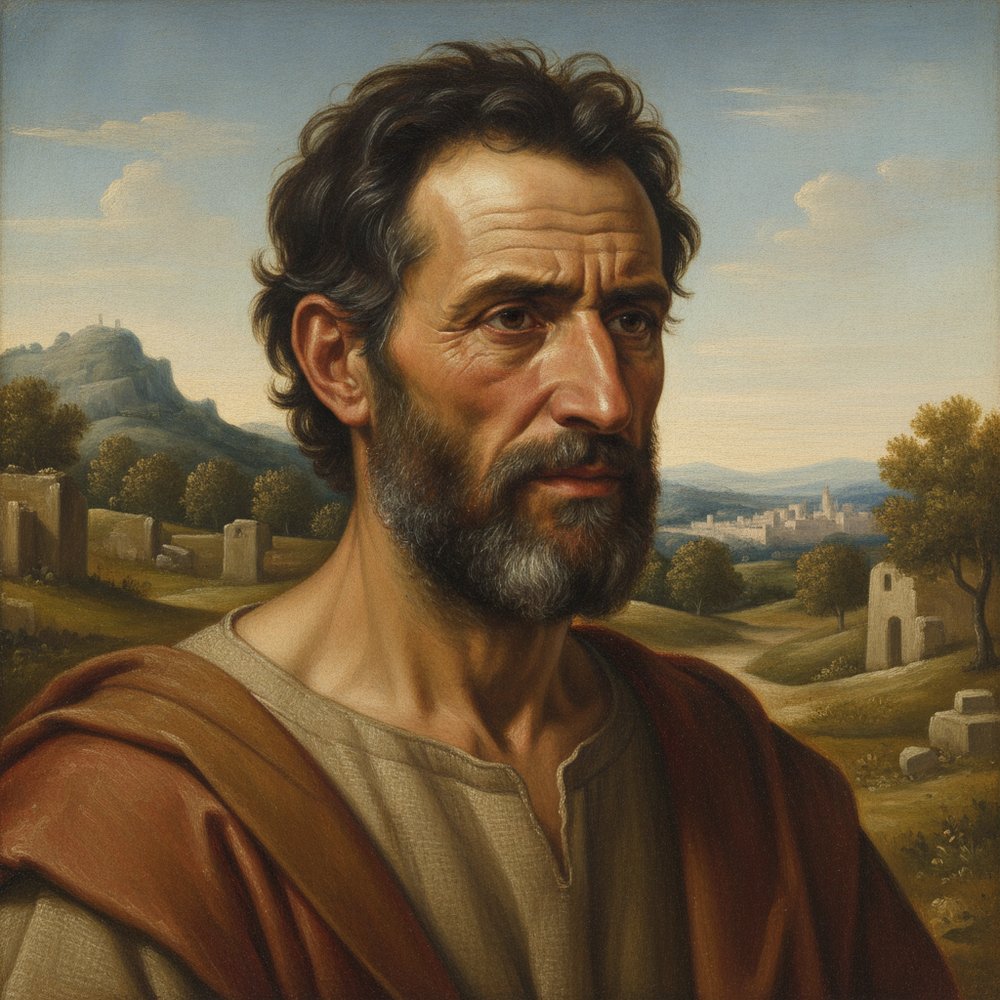
Illustration created for this project.


Crispus
The ruler of the synagogue at Corinth who believed in the Lord together with his entire household, after Paul had turned from the synagogue to preach next door. His conversion was followed by many other Corinthians believing and being baptised. Paul mentions him as one of the very few people he baptised personally there.
What we know — and how we know it
Bible — stated in scripture (with verse) · 1
Archaeology — physical evidence · 1
Scholarly — supported scholarly belief · 2
Origin & birthplace
Life, role & deeds
ArchaeologyCrispus is called the ruler (archisynagogos) of the Corinthian synagogue, and a stone lintel inscribed in Greek reading "[Syna]gogue of the Hebrews" was recovered at Corinth, physically attesting a Jewish synagogue in the city he led.
The "Synagogue of the Hebrews" lintel from Corinth ([ΣΥΝΑ]ΓΩΓΗ ΕΒΡ[ΑΙΩΝ]), recovered near the Lechaion Road and held in the Corinth Archaeological Museum; published as Corinth VIII.1, no. 111 (B. D. Meritt, Corinth, Vol. VIII, Part I: Greek Inscriptions 1896-1927, Harvard University Press, 1931). Honest caveat: the lettering is crude and paleographers date it broadly (often 2nd-5th c. AD, likely after Paul), so it confirms the institution and place, not Crispus personally.
ScholarlyLater Christian tradition, not the New Testament, numbers Crispus among the Seventy disciples and makes him a bishop of Aegina; this is a medieval hagiographic list rather than independent historical attestation.
Byzantine lists of the Seventy Apostles (Pseudo-Dorotheus). Framed as late tradition, not evidence.
Name & titles
Scholarly"Crispus" is a Latin cognomen meaning "curly-haired," fitting for a resident of the Roman colony of Corinth; that a synagogue leader bore a Latin name reflects the mixed Jewish-Roman civic culture of refounded Corinth.
Standard Latin onomastics: crispus = "curled/curly." Well attested as a Roman cognomen.
Where in scripture
Acts1 CorinthiansCrispus, the ruler of the synagogue, believed in the Lord with all his house. Many of the Corinthians, when they heard, believed and were baptized.
Acts 18:8 — Believed with all his household
I thank God that I baptized none of you, except Crispus and Gaius,
1 Corinthians 1:14
Scripture quotations are from the World English Bible, a public-domain translation.
Places in their life

Photo: CNG — CC BY-SA 3.0 (via Wikimedia Commons)