
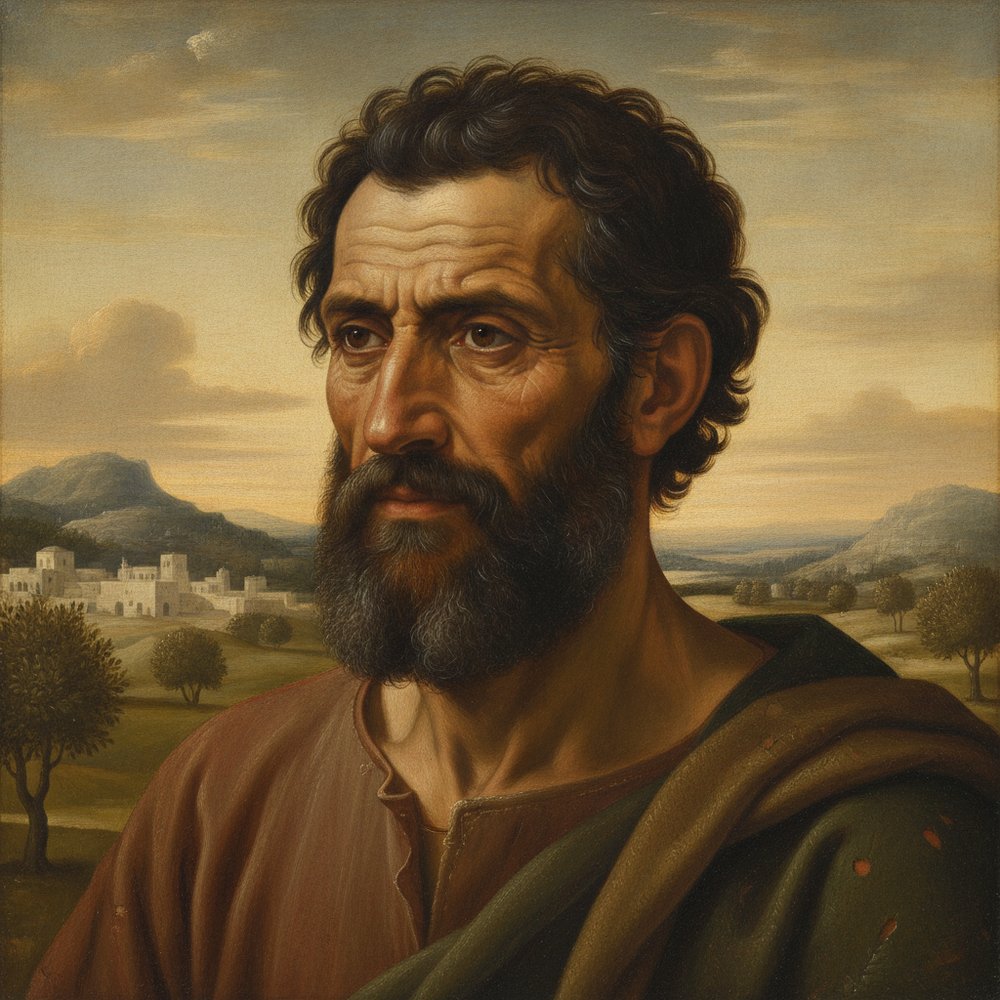
Illustration created for this project.



Dionysius the Areopagite
A member of the Areopagus council at Athens who believed after hearing Paul.
What we know — and how we know it
Bible — stated in scripture (with verse) · 1
Archaeology — physical evidence · 1
Ancient writers — non-biblical testimony · 1
Scholarly — supported scholarly belief · 1
Origin & birthplace
Travels
ArchaeologyThe Areopagus (Areios Pagos, 'Mars Hill'), the rocky outcrop northwest of the Athenian Acropolis where Acts places Paul's address and Dionysius' conversion, is a securely identified archaeological landmark in Athens.
The Areopagus site in Athens — the concrete named place tied to the account, not an inscription naming Dionysius himself. Wording corrected: the Areopagus is a natural limestone outcrop, a securely identified landmark, not itself an excavated dig.
Life, role & deeds
 Desconocido — Public domain (via Wikimedia Commons)
Ancient writersEusebius preserves a statement of Dionysius of Corinth (2nd century) that Dionysius the Areopagite, converted by Paul, became the first bishop of Athens. This is an early external notice, though it postdates the events by roughly a century.
Desconocido — Public domain (via Wikimedia Commons)
Ancient writersEusebius preserves a statement of Dionysius of Corinth (2nd century) that Dionysius the Areopagite, converted by Paul, became the first bishop of Athens. This is an early external notice, though it postdates the events by roughly a century.
Eusebius, Ecclesiastical History 4.23.3, quoting the letter of Dionysius of Corinth to the Athenians (c. 170 AD); cf. 3.4.10. An early external notice, but roughly a century after the events and ultimately anchored to the Acts tradition.
ScholarlyThe influential mystical-theology writings long circulated under his name (the Corpus Areopagiticum) are now universally regarded by scholars as pseudonymous, composed by an anonymous author of the late 5th or early 6th century AD conventionally called Pseudo-Dionysius.
Textual/authorship scholarship on the Corpus Areopagiticum; the attribution is a demonstrable pseudepigraphon, not evidence about the biblical figure.
Where in scripture
ActsBut certain men joined with him, and believed, among whom also was Dionysius the Areopagite, and a woman named Damaris, and others with them.
Acts 17:34 — Joins Paul and believes
Scripture quotations are from the World English Bible, a public-domain translation.
Places in their life

Photo: dronepicr — CC BY 2.0 (via Wikimedia Commons)