Solomon's Wisdom and the Two Mothers
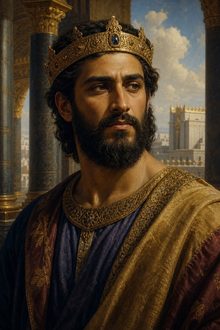
At Gibeon, God offers Solomon whatever he asks. He asks for a discerning heart to govern and to tell right from wrong — and is granted that, plus the riches and honour he did not request.
The test case follows immediately. Two women who share a house each claim the same living child; there are no witnesses. Solomon calls for a sword and orders the baby divided. One woman agrees to the ruling; the other gives up her claim rather than see it carried out, and Solomon awards her the child on the strength of it. Word of the judgment spreads, and the people conclude he has the wisdom of God to administer justice.
His reputation grew far beyond Israel — proverbs, songs, and knowledge of plants and animals — and later tradition attached the wisdom books of the Hebrew Bible to his name.
Where in scripture
[1] Solomon made an alliance with Pharaoh king of Egypt, and took Pharaoh’s daughter, and brought her into David’s city, until he had finished building his own house, Yahweh’s house, and the wall around Jerusalem. [2] However the people sacrificed in the high places, because there was not yet a house built for Yahweh’s name. [3] Solomon loved Yahweh, walking in the statutes of David his father; except that he sacrificed and burned incense in the high places. [4] The king went to Gibeon to sacrifice there; for that was the great high place. Solomon offered a thousand burnt offerings on that altar. [5] In Gibeon, Yahweh appeared to Solomon in a dream by night; and God said, “Ask for what I should give you.” …
1 Kings 3:1–28 — opening verses
[29] God gave Solomon abundant wisdom and understanding, and very great understanding, even as the sand that is on the seashore. [30] Solomon’s wisdom excelled the wisdom of all the children of the east and all the wisdom of Egypt. [31] For he was wiser than all men; than Ethan the Ezrahite, Heman, Calcol, and Darda, the sons of Mahol: and his fame was in all the nations all around. [32] He spoke three thousand proverbs; and his songs numbered one thousand five. [33] He spoke of trees, from the cedar that is in Lebanon even to the hyssop that grows out of the wall; he also spoke of animals, of birds, of creeping things, and of fish. [34] People of all nations came to hear the wisdom of Solomon, sent by all kings of the earth, who had heard of his wisdom.
1 Kings 4:29–34
[1] The proverbs of Solomon, the son of David, king of Israel: [2] to know wisdom and instruction; to discern the words of understanding; [3] to receive instruction in wise dealing, in righteousness, justice, and equity; [4] to give prudence to the simple, knowledge and discretion to the young man: [5] that the wise man may hear, and increase in learning; that the man of understanding may attain to sound counsel: [6] to understand a proverb, and parables, the words and riddles of the wise. [7] The fear of Yahweh is the beginning of knowledge; but the foolish despise wisdom and instruction.
Proverbs 1:1–7
Scripture quotations are from the World English Bible, a public-domain translation.