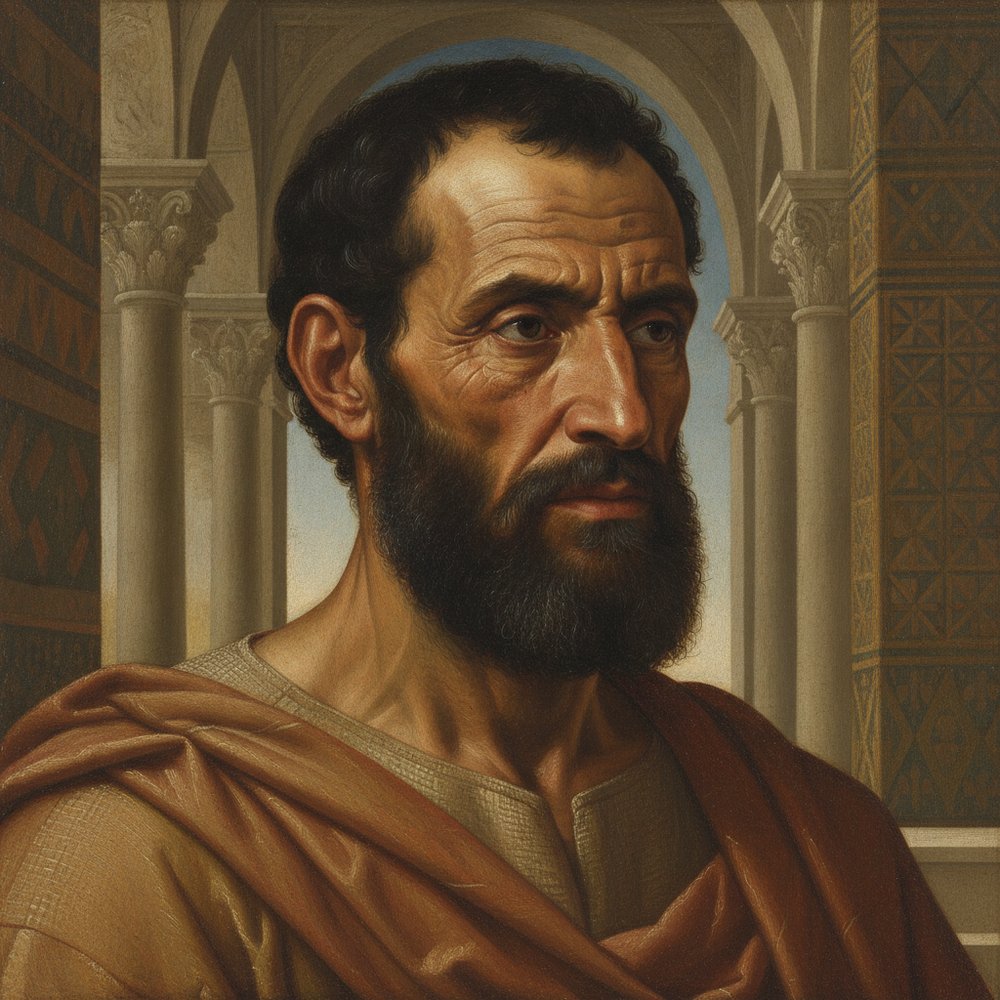
Illustration created for this project.
Agag
What we know — and how we know it
Ancient writers — non-biblical testimony · 1
Scholarly — supported scholarly belief · 2
Family & lineage
ScholarlyLater Jewish tradition links Haman "the Agagite" (Esther 3:1) genealogically to Agag the Amalekite, casting Israel's Persian-era enemy as a descendant of Saul's spared foe. This is an interpretive tradition, not an attested pedigree.
Tradition reflected in Josephus (Antiquities 11.209, calling Haman an Amalekite) and rabbinic/Targumic literature.
Death & legacy
 Scan by NYPL — Public domain (via Wikimedia Commons)
Ancient writersJosephus retells Saul sparing Agag and Samuel personally executing him, though his account is dependent on and derived from the biblical narrative rather than an independent source.
Scan by NYPL — Public domain (via Wikimedia Commons)
Ancient writersJosephus retells Saul sparing Agag and Samuel personally executing him, though his account is dependent on and derived from the biblical narrative rather than an independent source.
Josephus, Jewish Antiquities 6.136-137 (Saul spares Agag; Samuel personally executes him); derived from 1 Samuel 15, not an independent source. Text: ed./tr. R. Marcus, Loeb Classical Library, Josephus vol. V (Antiquities V-VIII), Harvard Univ. Press, 1934.
Name & titles
ScholarlyA number of scholars suspect "Agag" functioned as a dynastic title of Amalekite kings rather than a personal name, comparable to "Pharaoh" or "Abimelech." This is supported by Numbers 24:7, where Balaam's oracle uses "Agag" as a generic royal benchmark generations before Saul's opponent.
Comparative onomastic argument (title vs. name); the un-etymologized name has no secure Semitic derivation.
Where in scripture
1 SamuelSamuel said, “As your sword has made women childless, so your mother will be childless among women!” Then Samuel cut Agag in pieces before Yahweh in Gilgal.
1 Samuel 15:33 — Cut down by Samuel
Scripture quotations are from the World English Bible, a public-domain translation.
In their own words — 1 recorded saying
“Then Samuel said, Make Agag, the king of the Amalekites, come here to me. And Agag came to him shaking with fear. And Agag said, Truly the pain of death is past.” — 1 Samuel 15:32
Speaker attribution: Clear Bible MACULA (CC BY 4.0). Wording: Bible in Basic English (public domain).
In art


