
Esther
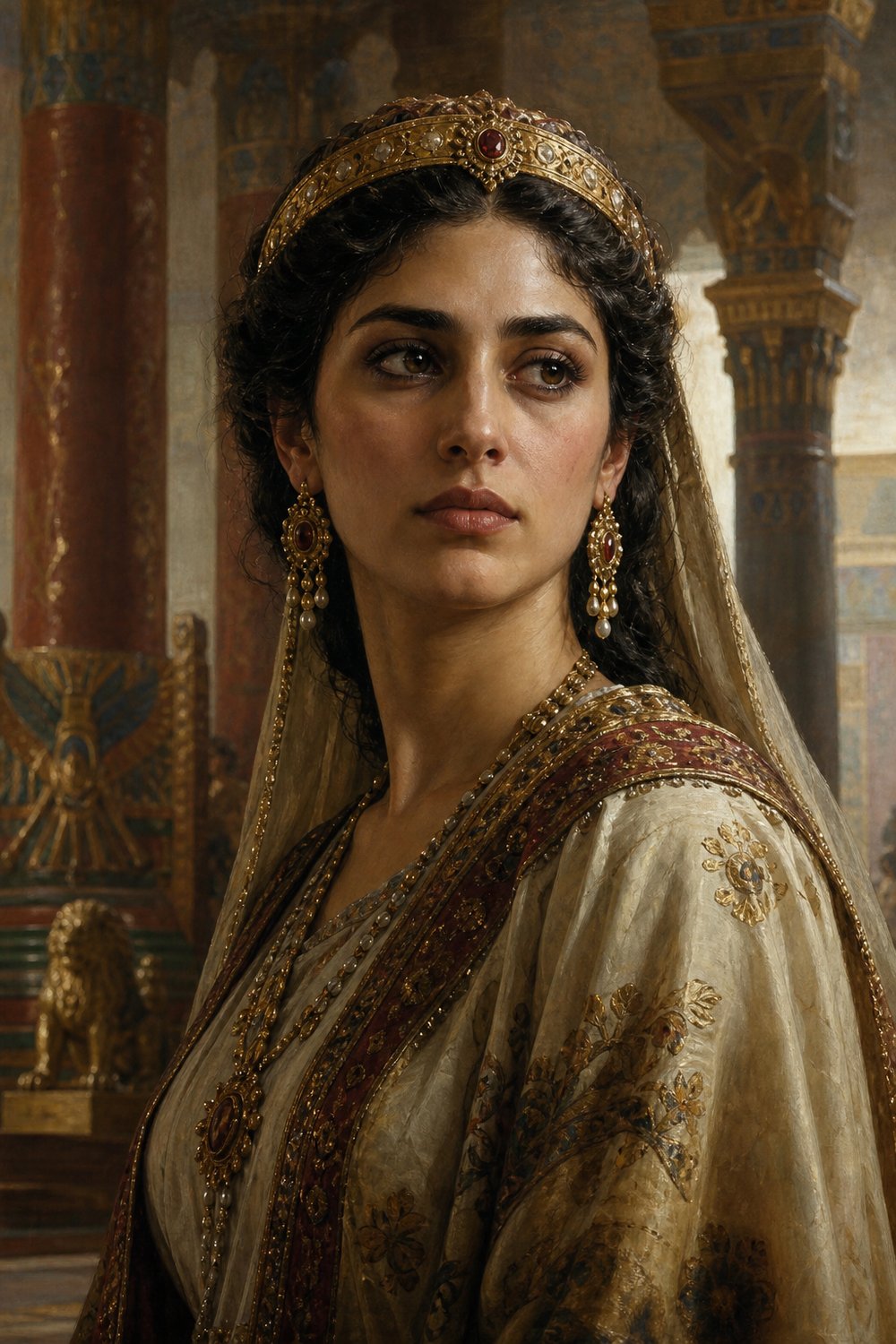
A Jewish orphan raised by her cousin Mordecai in the Persian capital of Susa, who was taken into the royal harem and chosen by King Ahasuerus as queen. When Haman secured a decree to destroy every Jew in the empire, Mordecai urged her to act — perhaps she had come to the kingdom for such a time as this. Concealing her people until then, she approached the king unsummoned at the risk of her life, exposed Haman at a banquet, and won a counter-decree allowing the Jews to defend themselves. The deliverance is remembered each year at the feast of Purim; the book that bears her name never once mentions God.
What we know — and how we know it
 Unknown authorUnknown author — Public domain (via Wikimedia Commons)
ArchaeologyThe Persian palace at Susa, where the book is set, has been excavated — and its layout matches the story's detailed descriptions of the court.
Unknown authorUnknown author — Public domain (via Wikimedia Commons)
ArchaeologyThe Persian palace at Susa, where the book is set, has been excavated — and its layout matches the story's detailed descriptions of the court.
Where in scripture
EstherHe brought up Hadassah, that is, Esther, his uncle’s daughter; for she had neither father nor mother. The maiden was fair and beautiful; and when her father and mother were dead, Mordecai took her for his own daughter.
Esther 2:7
The king loved Esther more than all the women, and she obtained favor and kindness in his sight more than all the virgins; so that he set the royal crown on her head, and made her queen instead of Vashti.
Esther 2:17 — Made queen
“Go, gather together all the Jews who are present in Shushan, and fast for me, and neither eat nor drink three days, night or day. I and my maidens will also fast the same way. Then I will go in to the king, which is against the law; and if I perish, I perish.”
Esther 4:16 — 'If I perish, I perish'
While they were yet talking with him, the king’s eunuchs came, and hurried to bring Haman to the banquet that Esther had prepared.
Esther 6:14
So the king and Haman came to banquet with Esther the queen.
Esther 7:1
On that day, King Ahasuerus gave the house of Haman, the Jews’ enemy, to Esther the queen. Mordecai came before the king; for Esther had told what he was to her.
Esther 8:1
The king said to Esther the queen, “The Jews have slain and destroyed five hundred men in the citadel of Susa, including the ten sons of Haman; what then have they done in the rest of the king’s provinces! Now what is your petition? It shall be granted you. What is your further request? It shall be done.”
Esther 9:12
Scripture quotations are from the World English Bible, a public-domain translation.
Family
In their own words — 7 recorded sayings
“It is common knowledge among all the king's servants and the people of every part of the kingdom, that if anyone, man or woman, comes to the king in his inner room without being sent for, there is only one law for him, that he is to be put to death; only those to whom the king's rod of gold is stretched out may keep their lives: but I have not been sent for to come before the king these thirty days.” — Esther 4:11
“Go, get together all the Jews who are present in Shushan, and go without food for me, taking no food or drink night or day for three days: and I and my women will do the same; and so I will go in to the king, which is against the law: and if death is to be my fate, then let it come.” — Esther 4:16
“And Esther in answer said, If it seems good to the king, let the king and Haman come today to the feast which I have made ready for him.” — Esther 5:4
“Then Esther said in answer, My prayer and my request is this: If I have the king's approval, and if it is the king's pleasure to give me my prayer and do my request, let the king and Haman come to the feast which I will make ready for them, and tomorrow I will do as the king has said.” — Esther 5:7-8
“Then Esther the queen, answering, said, If I have your approval, O king, and if it is the king's pleasure, let my life be given to me in answer to my prayer, and my people at my request: For we are given up, I and my people, to destruction and death and to be cut off. If we had been taken as men-servants and women-servants for a price, I would have said nothing, for our trouble is little in comparison with the king's loss.” — Esther 7:3-4
“And Esther said, Our hater and attacker is this evil Haman. Then Haman was full of fear before the king and the queen.” — Esther 7:6
“Then Esther said, If it is the king's pleasure, let authority be given to the Jews in Shushan to do tomorrow as has been done today, and let orders be given for the hanging of Haman's ten sons.” — Esther 9:13
Speaker attribution: Clear Bible MACULA (CC BY 4.0). Wording: Bible in Basic English (public domain).
Events
Places in their life

Photo: Marie-Lan Nguyen — Public domain (via Wikimedia Commons)
In art


