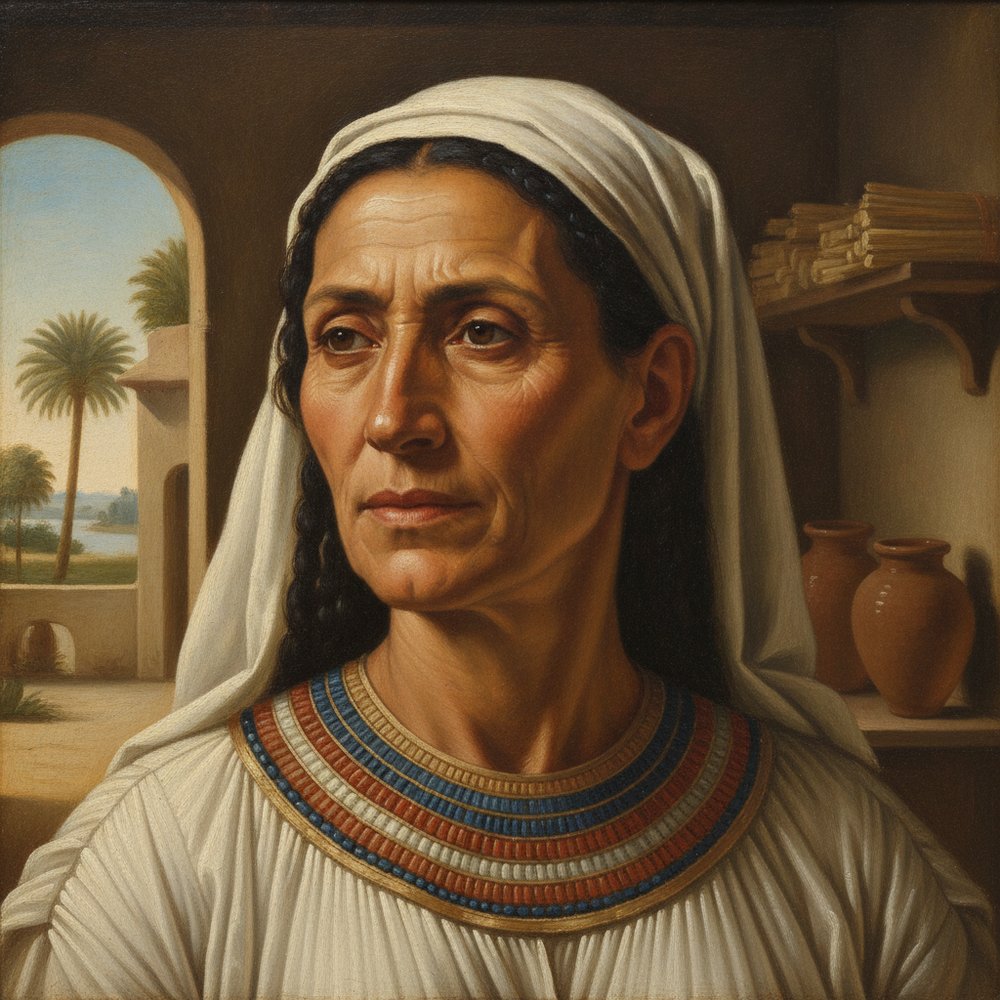
The daughter of Potiphera, priest of On, given to Joseph in marriage by Pharaoh when he was raised to govern Egypt. She bore him two sons before the famine years: Manasseh — 'God has made me forget all my hardship' — and Ephraim — 'God has made me fruitful in the land of my affliction'. Both were adopted by Jacob and became tribes of Israel.
ArchaeologyAsenath is called the daughter of Potiphera, 'priest of On' (Heliopolis), and On was a major, archaeologically well-documented cult center of the sun god Ra, still marked today by the standing obelisk of Senusret I. This attests the institution and place tied to her family, not Asenath herself.
Standing obelisk of Senusret I (12th Dynasty, c. 1940 BC) at Heliopolis/On, al-Matariyya, Cairo — sole survivor of the sun-temple of Ra; precinct excavated by the German-Egyptian mission (D. Raue); attests the cult setting, not the individual.
ScholarlyUnlike most biblical names, Asenath is a genuinely Egyptian name, most plausibly reflecting a form such as iw.s-n-Nit, 'she belongs to (the goddess) Neith' (with other proposals like 'belonging to her father'). Its authentic Egyptian character fits the narrative setting of a wife given to Joseph in Egypt.
Egyptian onomastics; the 'belonging to (deity)' name-type is common in Egyptian personal names.
Pharaoh called Joseph’s name Zaphenath-Paneah; and he gave him Asenath, the daughter of Potiphera priest of On as a wife. Joseph went out over the land of Egypt.
Born · Egypt Photo: KennyOMG — CC BY-SA 4.0 (via Wikimedia Commons)
In art
Joseph meets Asenath (Asenath throws the Idols out of the Tower))-Bode museum- Berlin · Yair Haklai — CC BY-SA 4.0 (via Wikimedia Commons)Asenath · Published by Guillaume Rouille (1518?-1589) — Public domain (via Wikimedia Commons)Joseph and Asenath · Owen Jones — Public domain (via Wikimedia Commons)
We'd like to set analytics cookies to understand how the site is used.
They're off unless you agree. See our privacy page.