
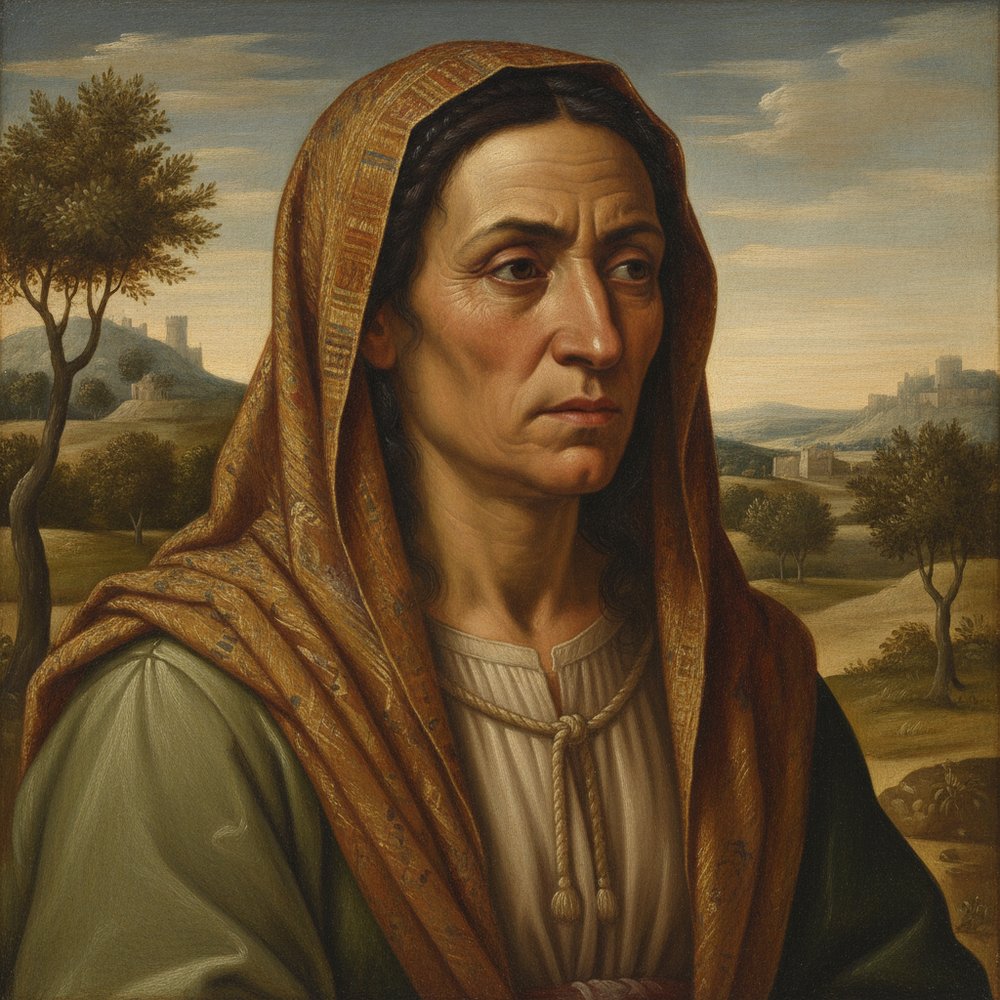
Illustration created for this project.


Gomer
The unfaithful wife of the prophet Hosea, whose marriage pictured God's steadfast love for wayward Israel.
What we know — and how we know it
Bible — stated in scripture (with verse) · 2
Archaeology — physical evidence · 1
Ancient writers — non-biblical testimony · 1
Scholarly — supported scholarly belief · 1
Family & lineage
Tribe & people
 Zunkir — CC BY-SA 4.0 (via Wikimedia Commons)
ArchaeologyGomer, listed as a son of Japheth and eponym of a people, is widely identified with the Cimmerians, who appear in Assyrian royal inscriptions as the Gimirraya (Gimirri). Texts from the reigns of Sargon II, Esarhaddon, and Ashurbanipal record this people's incursions across Anatolia and the Near East, attesting the nation Gomer represents rather than an individual.
Zunkir — CC BY-SA 4.0 (via Wikimedia Commons)
ArchaeologyGomer, listed as a son of Japheth and eponym of a people, is widely identified with the Cimmerians, who appear in Assyrian royal inscriptions as the Gimirraya (Gimirri). Texts from the reigns of Sargon II, Esarhaddon, and Ashurbanipal record this people's incursions across Anatolia and the Near East, attesting the nation Gomer represents rather than an individual.
Neo-Assyrian attestations of the Gimirrāya (Cimmerians): royal correspondence of Sargon II reporting their defeat of Urartu, c. 714 BC (State Archives of Assyria V, ed. Lanfranchi & Parpola, 1990); Esarhaddon's inscriptions recording the defeat of Teushpa the Cimmerian (RINAP 4, ed. E. Leichty, 2011); Ashurbanipal's inscriptions naming Tugdammî (Dugdammî), king of the Gimirri (RINAP 5, ed. Novotny & Jeffers, 2018). The identification Gomer = Cimmerians follows A. Ivantchik, 'Les Cimmériens au Proche-Orient' (Orbis Biblicus et Orientalis 127, 1993); attests the nation, not an individual.
 Scan by NYPL — Public domain (via Wikimedia Commons)
Ancient writersJosephus states that the descendants of Gomer, whom he calls the Gomarites, were known to the Greeks of his day as the Galatians (Galatae).
Scan by NYPL — Public domain (via Wikimedia Commons)
Ancient writersJosephus states that the descendants of Gomer, whom he calls the Gomarites, were known to the Greeks of his day as the Galatians (Galatae).
Josephus, Jewish Antiquities 1.123 (Whiston 1.6.1), trans. H. St. J. Thackeray, Loeb Classical Library (1930); Gomer's descendants (the 'Gomarites') equated with the Galatians/Galatae.
Name & titles
ScholarlyThe name Gomer (Gomer) is generally linked by scholars to Akkadian Gimirri and Greek Kimmerioi (Cimmerians), making it an ethnonym preserved as a personal name in the Table of Nations. This applies to Japheth's son; the unrelated Gomer, wife of Hosea, has no external attestation.
Comparative onomastics correlating Hebrew Gomer with Akkadian/Greek forms of 'Cimmerian.'
Where in scripture
HoseaSo he went and took Gomer the daughter of Diblaim; and she conceived, and bore him a son.
Hosea 1:3 — Hosea takes Gomer
Scripture quotations are from the World English Bible, a public-domain translation.