Hannah
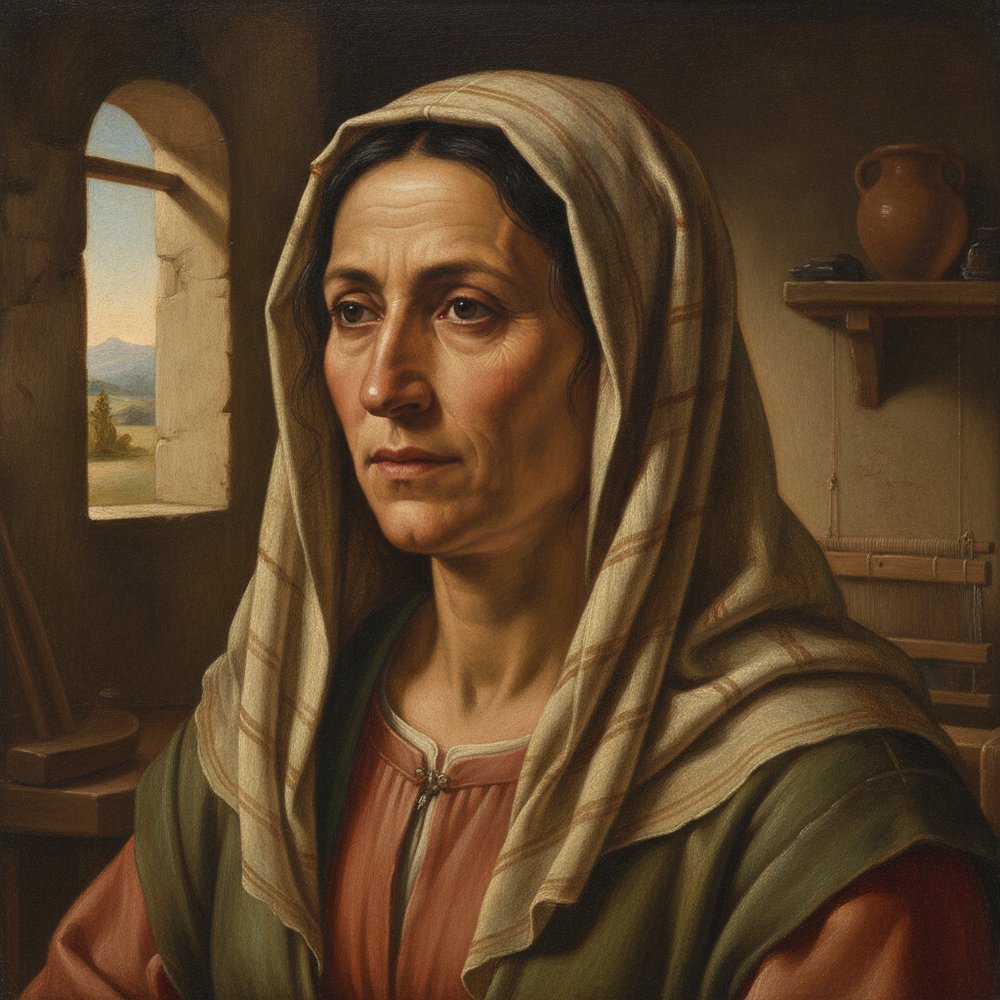
The wife of Elkanah, childless and provoked year after year by his other wife Peninnah. At the sanctuary in Shiloh she prayed with such intensity, her lips moving without sound, that Eli took her for drunk; she answered that she was pouring out her soul. She vowed that a son would be given to the Lord all his days, and when Samuel was born she kept the vow, bringing him to Eli once he was weaned and visiting each year with a little robe she had made. Her song of praise anticipates Mary's Magnificat.
What we know — and how we know it
 Scan by NYPL — Public domain (via Wikimedia Commons)
Ancient writersJosephus retells Hannah's story (naming her Anna) in his 'Jewish Antiquities', describing her vow, her prayer at Shiloh, and the birth of Samuel. This is a dependent paraphrase of the biblical account rather than independent attestation, so it confirms the tradition's early currency but not the figure historically.
Scan by NYPL — Public domain (via Wikimedia Commons)
Ancient writersJosephus retells Hannah's story (naming her Anna) in his 'Jewish Antiquities', describing her vow, her prayer at Shiloh, and the birth of Samuel. This is a dependent paraphrase of the biblical account rather than independent attestation, so it confirms the tradition's early currency but not the figure historically.
Where in scripture
1 SamuelHe had two wives. The name of one was Hannah, and the name of other Peninnah. Peninnah had children, but Hannah had no children.
1 Samuel 1:2
When the time had come, Hannah conceived, and bore a son; and she named him Samuel, saying, “Because I have asked him of Yahweh.”
1 Samuel 1:20 — Bears Samuel
Hannah prayed, and said: “My heart exults in Yahweh! My horn is exalted in Yahweh. My mouth is enlarged over my enemies, because I rejoice in your salvation.
1 Samuel 2:1 — Her song of praise
Yahweh visited Hannah, and she conceived, and bore three sons and two daughters. The child Samuel grew before Yahweh.
1 Samuel 2:21
Scripture quotations are from the World English Bible, a public-domain translation.
Family
In their own words — 6 recorded sayings
“And she made an oath, and said, O Lord of armies, if you will truly take note of the sorrow of your servant, not turning away from me but keeping me in mind, and will give me a man-child, then I will give him to the Lord all the days of his life, and his hair will never be cut.” — 1 Samuel 1:11
“And Hannah, answering him, said, No, my lord, I am a woman whose spirit is broken with sorrow: I have not taken wine or strong drink, but I have been opening my heart before the Lord. Do not take your servant to be a good-for-nothing woman: for my words have come from my stored-up sorrow and pain.” — 1 Samuel 1:15-16
“And she said, May your servant have grace in your eyes. So the woman went away, and took part in the feast, and her face was no longer sad.” — 1 Samuel 1:18
“Now the time came when Hannah, being with child, gave birth to a son; and she gave him the name Samuel, Because, she said, I made a prayer to the Lord for him.” — 1 Samuel 1:20
“But Hannah did not go, for she said to her husband, I will not go till the child has been taken from the breast, and then I will take him with me and put him before the Lord, where he may be for ever.” — 1 Samuel 1:22
“And she said, O my lord, as your soul is living, my lord, I am that woman who was making a prayer to the Lord here by your side:” — 1 Samuel 1:26
Speaker attribution: Clear Bible MACULA (CC BY 4.0). Wording: Bible in Basic English (public domain).
In art


