Absalom's Revolt
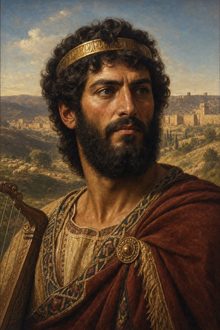
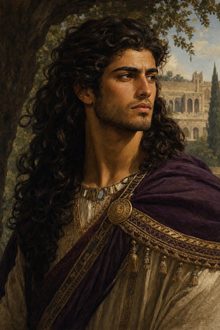
Absalom spends four years at the city gate intercepting people who have come to the king for justice, telling each that his case is good but there is no one to hear it, and kissing anyone who bows to him. The text says he stole the hearts of the men of Israel.
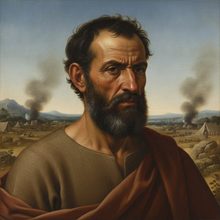
When the revolt breaks, David abandons Jerusalem rather than fight for it, walking up the Mount of Olives barefoot and weeping. The battle is fought in the forest of Ephraim, where the terrain kills more than the sword, and Absalom is caught in the branches of an oak by his head. Joab kills him there, against David's explicit order to deal gently with the young man.
The victory brings no relief. David's cry on the news — O Absalom, my son, my son — is among the most quoted expressions of grief in scripture.
Where in scripture
[1] After this, Absalom prepared a chariot and horses for himself, and fifty men to run before him. [2] Absalom rose up early, and stood beside the way of the gate. When any man had a suit which should come to the king for judgment, then Absalom called to him, and said, “What city are you from?” He said, “Your servant is of one of the tribes of Israel.” [3] Absalom said to him, “Behold, your matters are good and right; but there is no man deputized by the king to hear you.” [4] Absalom said moreover, “Oh that I were made judge in the land, that every man who has any suit or cause might come to me, and I would do him justice!” [5] It was so, that when any man came near to bow down to him, he stretched out his hand, and took hold of him, and kissed him. …
2 Samuel 15:1–37 — opening verses
[1] David counted the people who were with him, and set captains of thousands and captains of hundreds over them. [2] David sent the people out, a third part under the hand of Joab, and a third part under the hand of Abishai the son of Zeruiah, Joab’s brother, and a third part under the hand of Ittai the Gittite. The king said to the people, “I will also surely go out with you myself.” [3] But the people said, “You shall not go out; for if we flee away, they will not care for us; neither if half of us die, will they care for us. But you are worth ten thousand of us. Therefore now it is better that you are ready to help us out of the city.” …
2 Samuel 18:1–33 — opening verses
[1] Yahweh, how my adversaries have increased! Many are those who rise up against me. [2] Many there are who say of my soul, “There is no help for him in God.” Selah. [3] But you, Yahweh, are a shield around me, my glory, and the one who lifts up my head. [4] I cry to Yahweh with my voice, and he answers me out of his holy hill. Selah. [5] I laid myself down and slept. I awakened; for Yahweh sustains me. [6] I will not be afraid of tens of thousands of people who have set themselves against me on every side. [7] Arise, Yahweh! Save me, my God! For you have struck all of my enemies on the cheek bone. You have broken the teeth of the wicked. [8] Salvation belongs to Yahweh. Your blessing be on your people. Selah.
Psalms 3:1–8
Scripture quotations are from the World English Bible, a public-domain translation.