
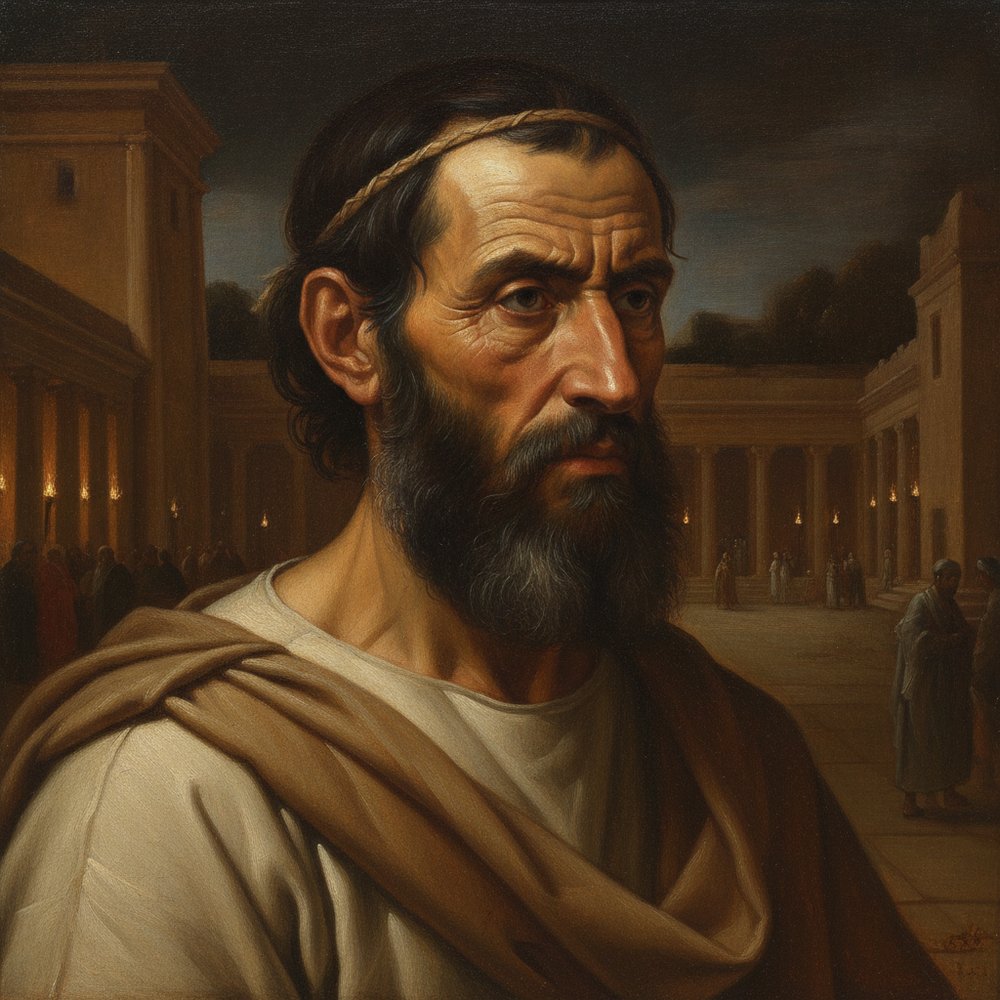
Illustration created for this project.

Eliashib
The high priest who helped rebuild Jerusalem's walls under Nehemiah.
What we know — and how we know it
Bible — stated in scripture (with verse) · 3
Ancient writers — non-biblical testimony · 1
Scholarly — supported scholarly belief · 2
Origin & birthplace
Family & lineage
ScholarlyThe Elephantine papyri, letters written in 407 BCE by the Jewish garrison in Egypt to Bagohi, governor of Judah, name 'Johanan the high priest' in Jerusalem. Johanan is the grandson of the high priest Eliashib in the priestly succession of Nehemiah 12, so the papyri independently anchor Eliashib's line and its chronology in the fifth century BCE.
Elephantine 'Bagohi' letters (Cowley 30-31 = TAD A4.7-4.8), 407 BCE.
 Scan by NYPL — Public domain (via Wikimedia Commons)
Ancient writersJosephus preserves the same chain of post-exilic high priests, listing Eliashib and his descendants Joiada, Johanan, and Jaddua, drawing on records for the succession down to the Persian and early Hellenistic period.
Scan by NYPL — Public domain (via Wikimedia Commons)
Ancient writersJosephus preserves the same chain of post-exilic high priests, listing Eliashib and his descendants Joiada, Johanan, and Jaddua, drawing on records for the succession down to the Persian and early Hellenistic period.
Josephus, Antiquities of the Jews 11.5.5 (11.297ff., Niese numbering), giving the high-priestly succession Eliashib–Joiada–Johanan–Jaddua; Loeb Classical Library vol. VI (Antiquities 9–11), trans. Ralph Marcus, 1937.
Tribe & people
BibleOf the tribe of Levi.
Nehemiah 3:1
Name & titles
ScholarlyEliashib (Elyashiv) means 'God restores' or 'God brings back' (El + the root shuv), a fitting name in the restoration-era priesthood of Nehemiah. The name is common in this period and is borne by several distinct men in Ezra-Nehemiah.
Onomastic analysis of El + shuv; standard Hebrew lexica (BDB, HALOT).
Where in scripture
NehemiahThen Eliashib the high priest rose up with his brothers the priests, and they built the sheep gate. They sanctified it, and set up its doors. They sanctified it even to the tower of Hammeah, to the tower of Hananel.
Nehemiah 3:1 — Builds the Sheep Gate
Scripture quotations are from the World English Bible, a public-domain translation.
Family
Places in their life

Photo: Godot13 — CC BY-SA 4.0 (via Wikimedia Commons)