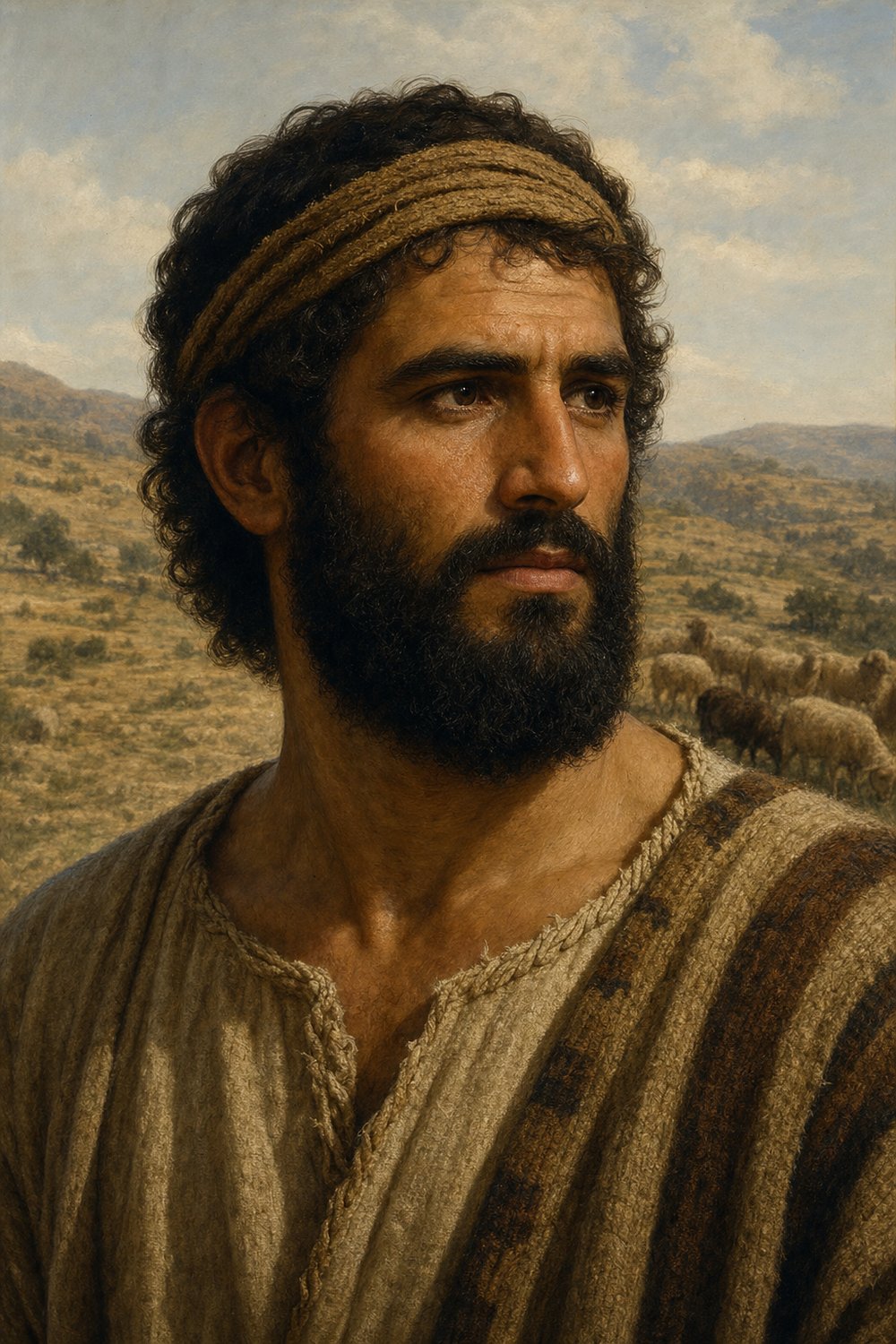
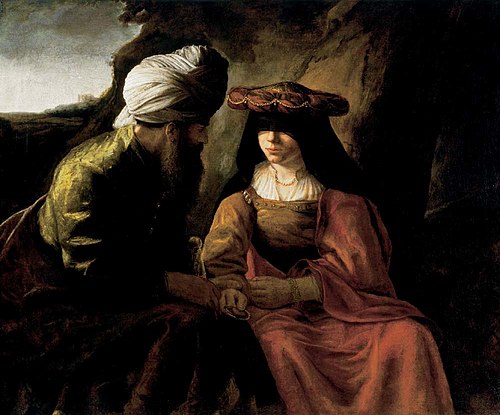
The fourth son of Jacob and Leah, and founder of the tribe from which the royal line came. It was Judah who proposed selling Joseph to the traders rather than killing him, and Judah who later offered himself as a slave in Benjamin's place — the speech that broke Joseph's composure. His own history includes the shameful episode with Tamar, in which she exposed his double standard and bore his sons. Jacob's blessing makes him a lion's whelp and promises that the sceptre shall not depart from Judah; from this line came David, and from David's line, Jesus.
ArchaeologyThe kingdom and territory bearing Judah's name are directly attested in Near Eastern inscriptions: the Assyrian annals of Sennacherib name Hezekiah "the Judahite," and the Tel Dan Stele's reference to the "House of David" points to the Judahite royal dynasty; these attest the polity named for the patriarch rather than the individual.
Sennacherib's Prism (Taylor Prism, British Museum; Oriental Institute Prism, Chicago) naming Hezekiah the Judahite (Hazaqiau amel Iaudaya), 701 BC campaign; and the Aramaic Tel Dan Stele's bytdwd ('House of David'), publ. A. Biran & J. Naveh, Israel Exploration Journal 43 (1993) and 45 (1995). Attest the polity named for the patriarch, not the individual.
ArchaeologyNumerous Iron Age Hebrew seals, bullae, and the LMLK ("belonging to the king") storage-jar stamps attest the administrative kingdom of Judah, the institution that carried the patriarch's name into the historical record.
LMLK ('belonging to the king') two- and four-winged storage-jar stamp impressions (naming Hebron, Socoh, Ziph, Mmšt), notably from the Sennacherib destruction of Lachish Level III (701 BCE, D. Ussishkin excavations); Judahite name-seal bullae published in N. Avigad, 'Hebrew Bullae from the Time of Jeremiah' (Israel Exploration Society, 1986).
Prophecy & fulfilment
BibleJacob's blessing that 'the sceptre shall not depart from Judah' was read as pointing to an everlasting kingship.
Genesis 49:10
Name & titles
ScholarlyThe Hebrew Yehudah is linked in the birth narrative to the verb yadah ("to praise/give thanks"), Leah declaring she will "praise the LORD"; the same consonantal root underlies the later national and linguistic terms Judea and "Jewish."
Onomastic derivation from the ydh "praise" root; standard Hebrew lexica (BDB, HALOT).
“And Judah said to his brothers, What profit is there in putting our brother to death and covering up his blood? Let us give him to these Ishmaelites for a price, and let us not put violent hands on him, for he is our brother, our flesh. And his brothers gave ear to him.”— Genesis 37:26-27
“Then Judah said to Onan, Go in to your brother's wife and do what it is right for a husband's brother to do; make her your wife and get offspring for your brother.”— Genesis 38:8
“Then Judah said to Tamar, his daughter-in-law, Go back to your father's house and keep yourself as a widow till my son Shelah becomes a man: for he had in his mind the thought that death might come to him as it had come to his brothers. So Tamar went back to her father's house.”— Genesis 38:11
“And turning to her by the roadside, he said to her, Let me come in to you; for he had no idea that she was his daughter-in-law. And she said, What will you give me as my price?”— Genesis 38:16
“And he said, I will give you a young goat from the flock. And she said, What will you give me as a sign till you send it?”— Genesis 38:17
“And he said, What would you have? And she said, Your ring and its cord and the stick in your hand. So he gave them to her and went in to her, and she became with child by him.”— Genesis 38:18
“And Judah said, Let her keep the things, so that we may not be shamed; I sent the young goat, but you did not see the woman.”— Genesis 38:23
“Now about three months after this, word came to Judah that Tamar, his daughter-in-law, had been acting like a loose woman and was with child. And Judah said, Take her out and let her be burned.”— Genesis 38:24
…and 10 more recorded sayings.
Speaker attribution: Clear Bible MACULA (CC BY 4.0). Wording: Bible in Basic English (public domain).
In art
John in Korovniki church - patriarch 13 Judah (c. 1654, Yaroslavl) · AnonymousUnknown author — Public domain (via Wikimedia Commons)Judah · Francisco de Zurbarán — Public domain (via Wikimedia Commons)Children of Jacob sell his brother Joseph · Konstantin Flavitsky — Public domain (via Wikimedia Commons)Judah and Tamar · School of Rembrandt — Public domain (via Wikimedia Commons)Juda Twaalf zonen van Jakob (serietitel), RP-P-BI-6556X · Rijksmuseum — CC0 (via Wikimedia Commons)Judah, from the series The Twelve Patriarchs · Maarten van Heemskerck / Dirck Volckertszoon Coornhert — CC0 (via Wikimedia Commons)Judah, from the series The Twelve Patriarchs · Maarten van Heemskerck / Dirck Volckertszoon Coornhert — CC0 (via Wikimedia Commons)The Phillip Medhurst Picture Torah 259. Judah. Genesis cap 49 vv 9-12. De Geyn · Philip De Vere — CC BY-SA 3.0 (via Wikimedia Commons)The Phillip Medhurst Picture Torah 260. Judah crouching as a lion. Genesis cap 49 v 9. Heuman · Philip De Vere — CC BY-SA 3.0 (via Wikimedia Commons)Deus e Judá (Biblioteca Nacional de Portugal ALC.455, fl.71) · Unknown authorUnknown author — Public domain (via Wikimedia Commons)
We'd like to set analytics cookies to understand how the site is used.
They're off unless you agree. See our privacy page.