The Stoning of Stephen
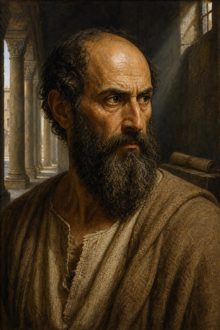
Stephen is one of seven men appointed to settle a fair distribution of food between Greek-speaking and Hebrew-speaking widows — an administrative post — and turns out to be an unanswerable debater. Opponents produce witnesses to accuse him of speaking against the temple and the law.
His defence is the longest speech in Acts, and it is a retelling of Israel's history in which God is repeatedly at work outside the holy places — with Abraham in Mesopotamia, Joseph in Egypt, Moses in the desert. Only at the end does he turn on his hearers.
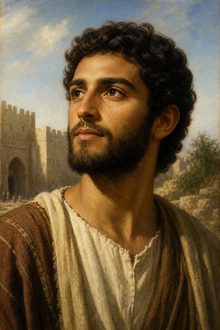
They stone him outside the city. He dies asking that the sin not be held against them, echoing Jesus from the cross. Luke adds one detail, almost in passing: the witnesses laid their coats at the feet of a young man named Saul — and the persecution that follows scatters the church, and the message, out of Jerusalem.
Where in scripture
[1] Now in those days, when the number of the disciples was multiplying, a complaint arose from the Hellenists against the Hebrews, because their widows were neglected in the daily service. [2] The twelve summoned the multitude of the disciples and said, “It is not appropriate for us to forsake the word of God and serve tables. [3] Therefore select from among you, brothers, seven men of good report, full of the Holy Spirit and of wisdom, whom we may appoint over this business. [4] But we will continue steadfastly in prayer and in the ministry of the word.” [5] These words pleased the whole multitude. They chose Stephen, a man full of faith and of the Holy Spirit, Philip, Prochorus, Nicanor, Timon, Parmenas, and Nicolaus, a proselyte of Antioch; …
Acts 6:1–15 — opening verses
[1] The high priest said, “Are these things so?” [2] He said, “Brothers and fathers, listen. The God of glory appeared to our father Abraham, when he was in Mesopotamia, before he lived in Haran, [3] and said to him, ‘Get out of your land, and from your relatives, and come into a land which I will show you.’ [4] Then he came out of the land of the Chaldaeans, and lived in Haran. From there, when his father was dead, God moved him into this land, where you are now living. [5] He gave him no inheritance in it, no, not so much as to set his foot on. He promised that he would give it to him for a possession, and to his offspring after him, when he still had no child. …
Acts 7:1–60 — opening verses
[1] Saul was consenting to his death. A great persecution arose against the assembly which was in Jerusalem in that day. They were all scattered abroad throughout the regions of Judea and Samaria, except for the apostles. [2] Devout men buried Stephen, and lamented greatly over him. [3] But Saul ravaged the assembly, entering into every house, and dragged both men and women off to prison. [4] Therefore those who were scattered abroad went around preaching the word.
Acts 8:1–4
Scripture quotations are from the World English Bible, a public-domain translation.