
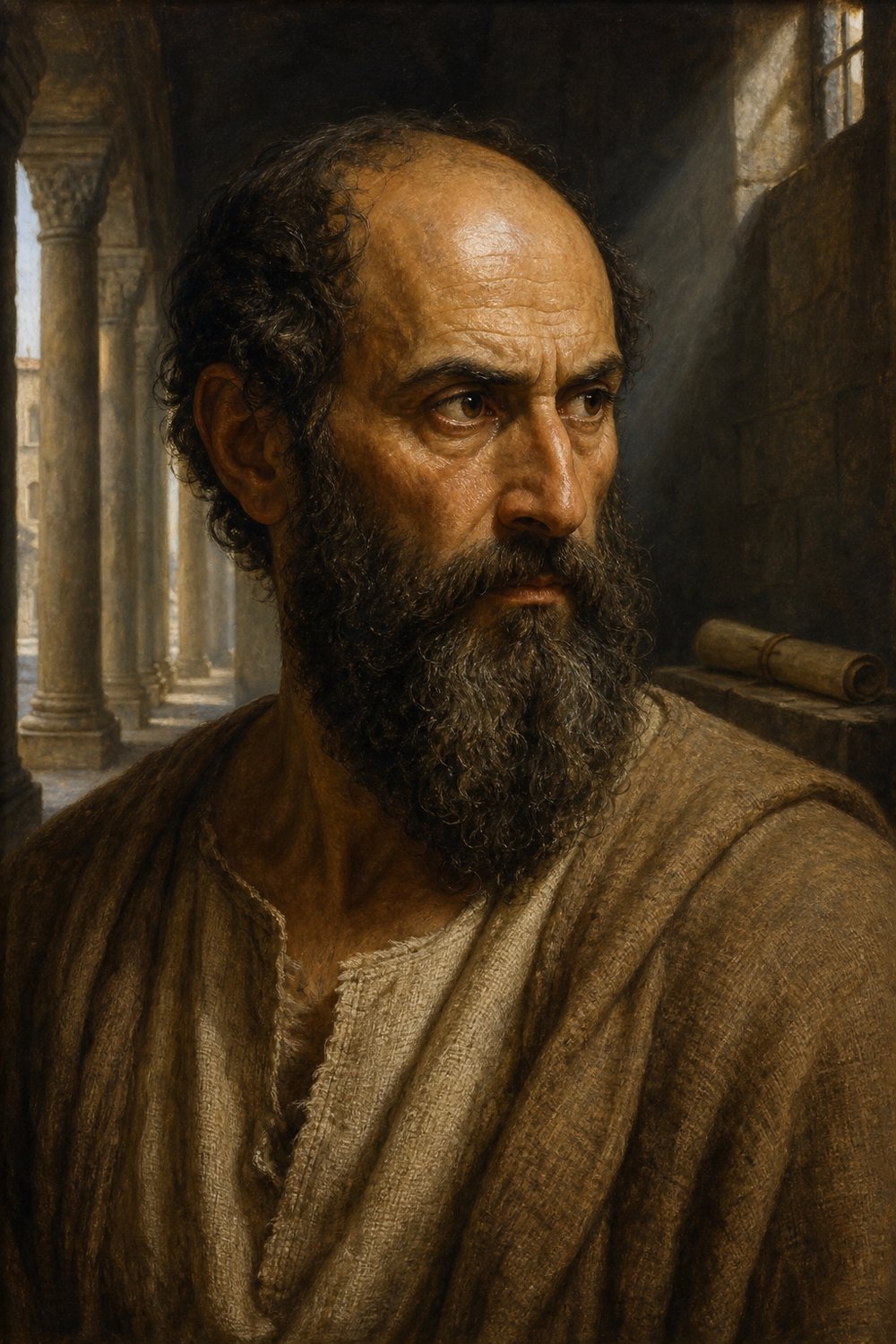


Paul the Apostle — apostle to the Gentiles
Born Saul, a Jew of Tarsus in Cilicia and a Roman citizen, trained as a Pharisee under Gamaliel and at first a fierce persecutor of the church. After his encounter with the risen Christ on the road to Damascus he became the foremost missionary of the early church — the apostle to the Gentiles. Across three great journeys and a final voyage to Rome he planted churches throughout Asia Minor and Greece, and thirteen New Testament letters bear his name. A tentmaker by trade, he was, by tradition, martyred at Rome.
What we know — and how we know it
 Gérard — CC BY-SA 4.0 (via Wikimedia Commons)
ArchaeologyThe Gallio inscription at Delphi dates the proconsul before whom Paul appeared at Corinth, fixing his stay there to about AD 51–52 — an anchor for the whole New-Testament chronology.
Gérard — CC BY-SA 4.0 (via Wikimedia Commons)
ArchaeologyThe Gallio inscription at Delphi dates the proconsul before whom Paul appeared at Corinth, fixing his stay there to about AD 51–52 — an anchor for the whole New-Testament chronology.
 Ktiv — CC BY-SA 4.0 (via Wikimedia Commons)
ArchaeologyA paving inscription at Corinth names 'Erastus', a city treasurer — the name Paul gives greeting from in Romans.
Ktiv — CC BY-SA 4.0 (via Wikimedia Commons)
ArchaeologyA paving inscription at Corinth names 'Erastus', a city treasurer — the name Paul gives greeting from in Romans.
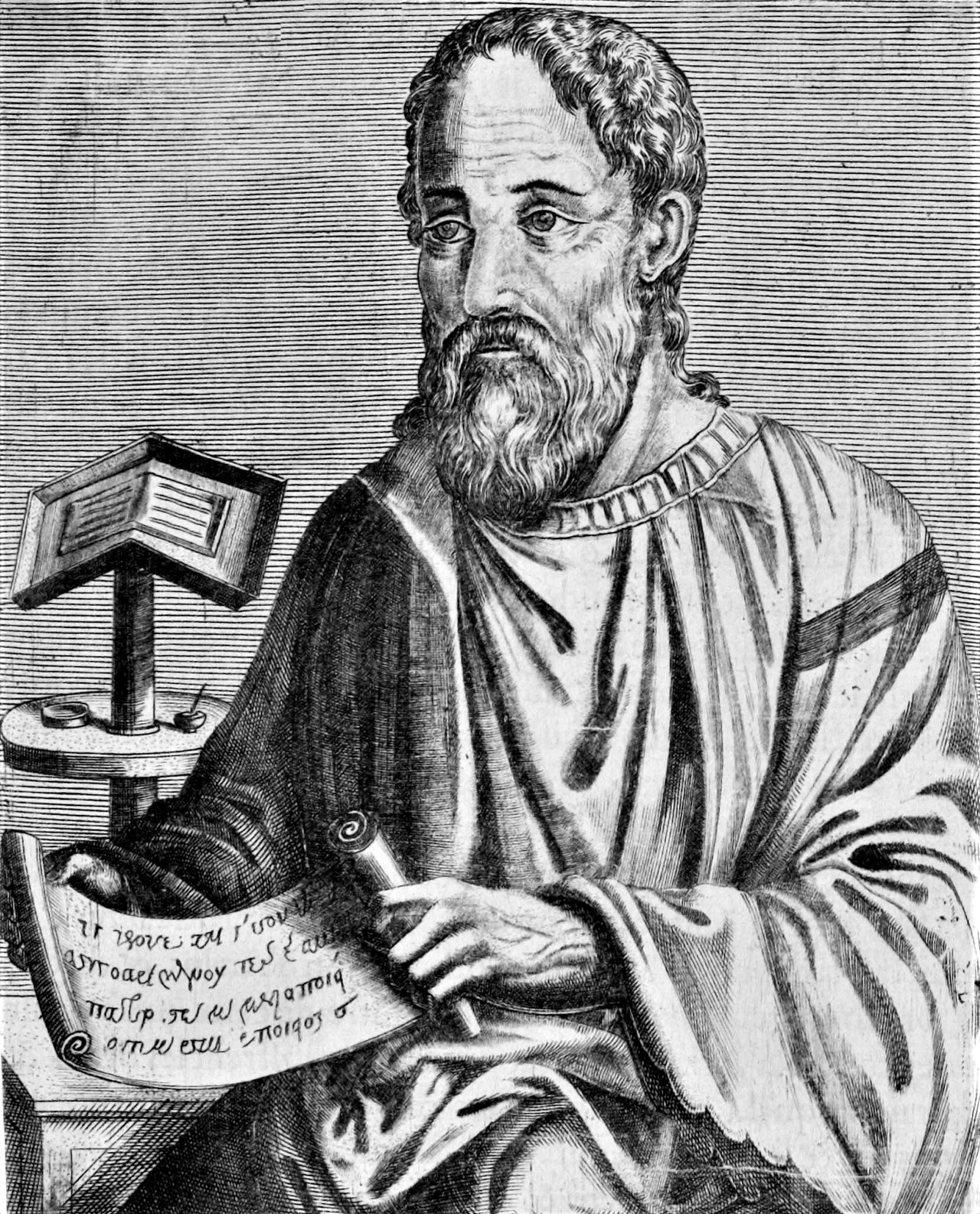 Desconocido — Public domain (via Wikimedia Commons)
Ancient writersTradition holds he was beheaded near Rome under Nero, c. AD 64–67.
Desconocido — Public domain (via Wikimedia Commons)
Ancient writersTradition holds he was beheaded near Rome under Nero, c. AD 64–67.
Where in scripture
1 Samuel1 ChroniclesPsalmsIsaiahActsRomans1 Corinthians2 CorinthiansGalatiansEphesiansPhilippiansColossians1 Thessalonians2 Thessalonians1 Timothy2 TimothyTitusPhilemon“The bows of the mighty men are broken. Those who stumbled are armed with strength.
1 Samuel 2:4
The word of Samuel came to all Israel. Now Israel went out against the Philistines to battle, and encamped beside Ebenezer; and the Philistines encamped in Aphek.
1 Samuel 4:1
The Philistines took God’s ark, and brought it into the house of Dagon, and set it by Dagon.
1 Samuel 5:2
When the five lords of the Philistines had seen it, they returned to Ekron the same day.
1 Samuel 6:16
Samuel judged Israel all the days of his life.
1 Samuel 7:15
Now there was a man of Benjamin, whose name was Kish, the son of Abiel, the son of Zeror, the son of Becorath, the son of Aphiah, the son of a Benjamite, a mighty man of valor.
1 Samuel 9:1
He had a son, whose name was Saul, an impressive young man; and there was not among the children of Israel a better person than he. From his shoulders and upward he was taller than any of the people.
1 Samuel 9:2
Now therefore stand still, that I may plead with you before Yahweh concerning all the righteous acts of Yahweh, which he did to you and to your fathers.
1 Samuel 12:7
Scripture quotations are from the World English Bible, a public-domain translation.
In their own words — 46 recorded sayings
“Then Saul said to the servant who had the care of his arms, Take your sword and put it through me, before these men without circumcision come and make sport of me. But his servant, full of fear, would not do so. Then Saul took out his sword, falling on it himself.” — 1 Chronicles 10:4
“O you, who are full of false tricks and evil ways, a son of the Evil One, hating all righteousness, will you for ever be turning people from the right ways of the Lord? And now, see, the hand of the Lord is on you, and you will be blind and not able to see the sun for a time. And straight away a dark mist came down on him; and he went about looking for a guide.” — Acts 13:10-11
“And Paul, getting up and making a sign with his hand, said, Men of Israel, and you who have the fear of God, give ear. The God of this people Israel made selection of our fathers, lifting the people up from their low condition when they were living in the land of Egypt, and with a strong arm took them out of it. And for about forty years he put up with their ways in the waste land. And having put to destruction seven nations in the land of Canaan, he gave them the land for their heritage for about four hundred and fifty years. And after these things he gave them judges, till the time of…” — Acts 13:16-41
“Then Paul and Barnabas without fear said, It was necessary for the word of God to be given to you first; but because you will have nothing to do with it, and have no desire for eternal life, it will now be offered to the Gentiles. For so the Lord has given us orders, saying, I have given you for a light to the Gentiles so that you may be for salvation to the ends of the earth.” — Acts 13:46-47
“Said in a loud voice, Get up on your feet. And, jumping up, he went walking about.” — Acts 14:10
“Good people, why are you doing these things? We are men with the same feelings as you, and we give you the good news so that you may be turned away from these foolish things to the living God, who made the heaven and the earth and the sea and all things in them: Who in the past let all nations go in the ways which seemed good to them. But he was not without witness, because he did good, and gave you rain from heaven and times of fruit, making your hearts full of food and joy.” — Acts 14:15-17
“And after some days, Paul said to Barnabas, Let us go back and see the brothers in every town where we have given the word of God, and see how they are.” — Acts 15:36
“And this she did on a number of days. But Paul was greatly troubled and, turning, said to the spirit, I give you orders in the name of Jesus Christ, to come out of her. And it came out that very hour.” — Acts 16:18
…and 38 more recorded sayings.
Speaker attribution: Clear Bible MACULA (CC BY 4.0). Wording: Bible in Basic English (public domain).
Connections
- Associate of Barnabas — First-journey partner
- Associate of Silas — Second-journey companion
- Associate of Timothy — His 'true child in the faith'
- Associate of Luke the Evangelist — Physician and chronicler
- Associate of Simon Peter — Fellow apostle; confronted at Antioch
Journeys
First missionary journey
With Barnabas and John Mark, from Antioch through Cyprus and into the highlands of Asia Minor, planting the first Gentile churches.
- Antioch · AD 46 — Sent out from the church
- Seleucia Pieria · AD 46 — Port of departure
- Salamis · AD 46 — Preaching in the synagogues of Cyprus
- Paphos · AD 47 — The proconsul Sergius Paulus believes
- Perga · AD 47 — John Mark turns back to Jerusalem
- Antioch of Pisidia · AD 47 — Paul's great synagogue sermon
- Iconium · AD 47 — Signs and a plot to stone them
- Lystra · AD 47 — Paul stoned and left for dead
- Derbe · AD 48 — Many disciples made — the turning point
- Attalia · AD 48 — Sailing home
- Antioch · AD 48 — Report to the sending church
Second missionary journey
With Silas (and, from Lystra, Timothy), Paul crosses for the first time into Europe — Macedonia and Greece.
- Antioch · AD 49 — Setting out again
- Derbe · AD 49 — Revisiting the churches
- Lystra · AD 49 — Timothy joins the mission
- Troas · AD 50 — The vision of the man of Macedonia
- Neapolis · AD 50 — First landing in Europe
- Philippi · AD 50 — Lydia converted; Paul and Silas imprisoned
- Thessalonica · AD 50 — A church founded amid uproar
- Berea · AD 51 — The noble-minded who searched the scriptures
- Athens · AD 51 — The sermon at the Areopagus
- Corinth · AD 51 — Eighteen months; letters to Thessalonica
- Cenchreae · AD 52 — Sailing east
- Ephesus · AD 52 — A brief first visit
- Caesarea · AD 52 — Landing in Judea
- Antioch · AD 52 — Home again
The voyage to Rome
A prisoner appealing to Caesar, shipwrecked on Malta, and brought at last to Rome.
- Caesarea · AD 59 — Sent under guard
- Sidon · AD 59 — Allowed to visit friends
- Myra · AD 59 — Transferred to an Alexandrian grain ship
- Fair Havens · AD 59 — The fateful decision to sail on
- Malta · AD 60 — Shipwreck; the viper and the healings
- Puteoli · AD 60 — Landing in Italy
- Rome · AD 60 — Two years under house arrest
Third missionary journey
Strengthening the churches, with a long and fruitful stay at Ephesus, then back through Macedonia and Greece toward Jerusalem.
- Antioch · AD 53 — Setting out
- Antioch of Pisidia · AD 53 — Revisiting Galatia
- Ephesus · AD 54 — Three years; the riot of the silversmiths
- Troas · AD 56 — Eutychus raised
- Philippi · AD 56 — Through Macedonia
- Corinth · AD 57 — Three months; the letter to the Romans written
- Miletus · AD 57 — Farewell to the Ephesian elders
- Caesarea · AD 57 — Warned of chains ahead
- Jerusalem · AD 57 — Arrested in the temple
Events
- The Conversion of Paul
- The Stoning of Stephen
- Paul's First Missionary Journey
- The Council of Jerusalem
- Paul and Silas in Prison at Philippi
- Paul at the Areopagus in Athens
- The Riot of the Silversmiths at Ephesus
- Paul Reaches Rome
- The Shipwreck on Malta
Places in their life

Photo: The Mersinli — CC BY-SA 4.0 (via Wikimedia Commons)

Photo: Unknown artistUnknown artist — CC BY 2.5 (via Wikimedia Commons)

Photo: Htkava — CC BY-SA 3.0 (via Wikimedia Commons)

Photo: Gerhard Haubold — CC BY-SA 3.0 (via Wikimedia Commons)

Photo: Dmitry Panov — CC BY 3.0 (via Wikimedia Commons)

Photo: Saffron Blaze — CC BY-SA 3.0 (via Wikimedia Commons)

Photo: Maderibeyza at Turkish Wikipedia — CC BY-SA 3.0 (via Wikimedia Commons)

Photo: Konya Karatay Belediyesi — CC BY 4.0 (via Wikimedia Commons)
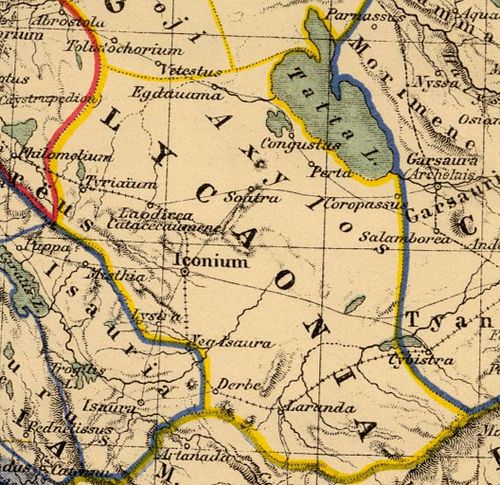
Photo: Heinrich Kiepert — Public domain (via Wikimedia Commons)

Photo: Esginmurat — CC BY-SA 4.0 (via Wikimedia Commons)

Photo: Horacio36 — CC BY-SA 3.0 (via Wikimedia Commons)
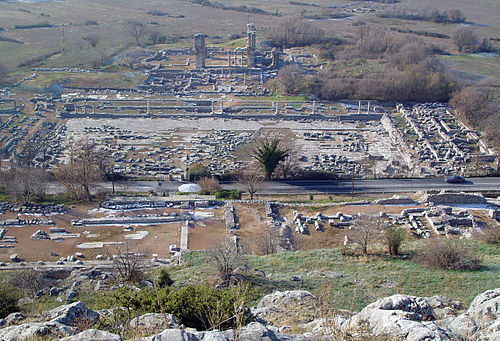
Photo: No machine-readable author provided. Marsyas assumed (based on copyright claims). — CC BY-SA 3.0 (via Wikimedia Commons)

Photo: Berthold Werner — CC BY-SA 3.0 (via Wikimedia Commons)

Photo: Zisis Tsampalis — CC BY-SA 3.0 (via Wikimedia Commons)

Photo: dronepicr — CC BY 2.0 (via Wikimedia Commons)

Photo: CNG — CC BY-SA 3.0 (via Wikimedia Commons)

Photo: Heinz Schmitz — CC BY-SA 2.5 (via Wikimedia Commons)

Photo: Turkish Central Bank — Public domain (via Wikimedia Commons)

Photo: The original uploader was אסף.צ at Hebrew Wikipedia. — Public domain (via Wikimedia Commons)

Photo: Vyacheslav Argenberg — CC BY 4.0 (via Wikimedia Commons)

Photo: Ingo Mehling — CC BY-SA 3.0 (via Wikimedia Commons)

Photo: Thomas Spratt — Public domain (via Wikimedia Commons)

Photo: Francesco Maltese — Public domain (via Wikimedia Commons)

Photo: © Ra Boe / Wikipedia Create the proper attribution for your usage by clicking on this button! This file is licensed under the Creative Commons Attribution-Share Alike 3.0 Germany license.Attribut — CC BY-SA 3.0 de (via Wikimedia Commons)

Photo: Jean-Pol GRANDMONT — CC BY-SA 3.0 (via Wikimedia Commons)

Photo: Bernard Gagnon — CC BY-SA 3.0 (via Wikimedia Commons)

Photo: Godot13 — CC BY-SA 4.0 (via Wikimedia Commons)
In art


