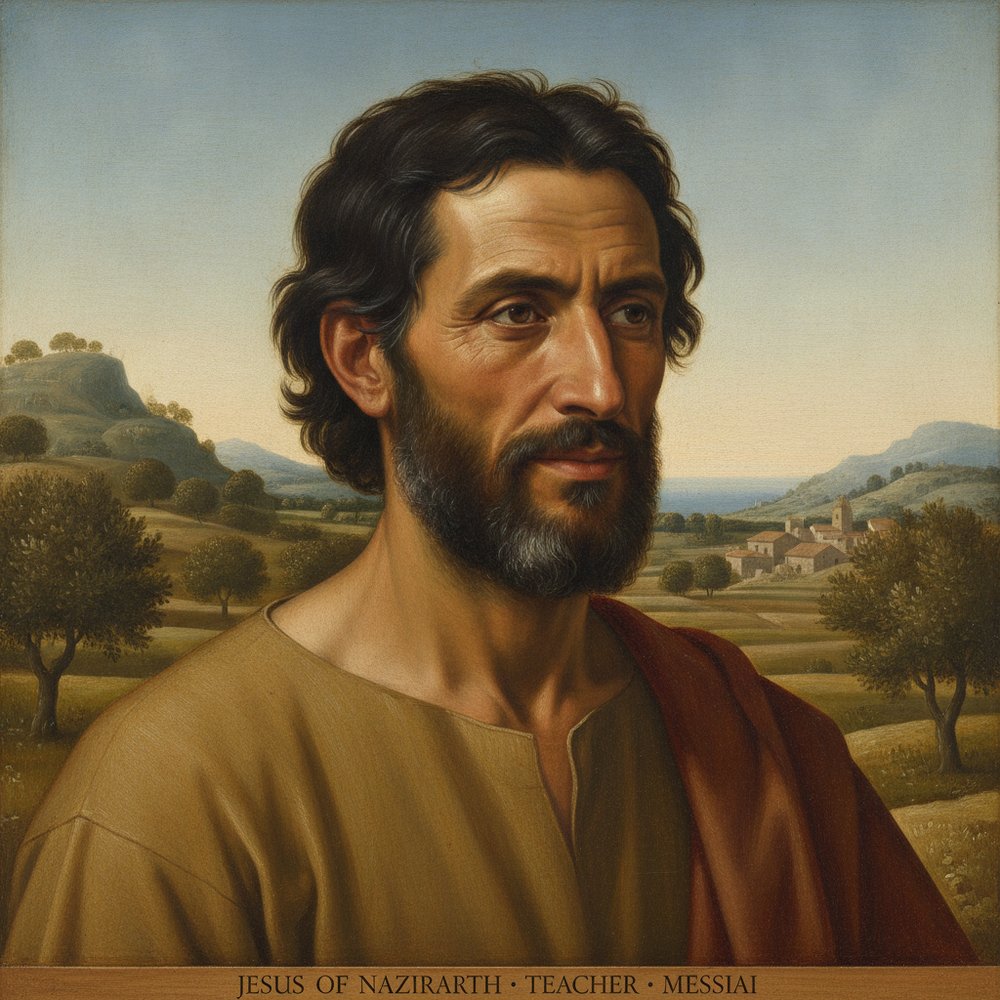
Jesus of Nazareth — the Christ
The central figure of the New Testament, born in Bethlehem and raised in Nazareth of Galilee. He called the twelve apostles, taught across Galilee and Judea, and was crucified in Jerusalem under Pontius Pilate. The four Gospels record his teaching, death and resurrection.
What we know — and how we know it
![The 'Pilate Stone' (Israel Museum, Jerusalem; replica in situ at Caesarea Maritima), a limestone dedication naming '[Po]ntius Pilatus, praefectus Iudaeae', found reused in the Roman theatre in 1961 by the Italian expedition under Antonio Frova; ed. A. Frova, 'L'iscrizione di Ponzio Pilato a Cesarea', Rendiconti dell'Istituto Lombardo 95 (1961), 419-434.](https://upload.wikimedia.org/wikipedia/commons/thumb/7/7e/Pilate_Stone_copy_Milano_transcripted.jpg/900px-Pilate_Stone_copy_Milano_transcripted.jpg) Reinhard Dietrich — CC BY-SA 4.0 (via Wikimedia Commons)
ArchaeologyPontius Pilate, who condemned him, is named on a 1st-century inscription found at Caesarea in 1961 — independent evidence the prefect existed.
Reinhard Dietrich — CC BY-SA 4.0 (via Wikimedia Commons)
ArchaeologyPontius Pilate, who condemned him, is named on a 1st-century inscription found at Caesarea in 1961 — independent evidence the prefect existed.
 Julien — Public domain (via Wikimedia Commons)
Ancient writersThe Roman historian Tacitus, writing c. AD 116, records that 'Christus' was executed by the procurator Pontius Pilate in the reign of Tiberius — hostile testimony to Jesus's death.
Julien — Public domain (via Wikimedia Commons)
Ancient writersThe Roman historian Tacitus, writing c. AD 116, records that 'Christus' was executed by the procurator Pontius Pilate in the reign of Tiberius — hostile testimony to Jesus's death.
 Scan by NYPL — Public domain (via Wikimedia Commons)
Ancient writersThe Jewish historian Josephus names Jesus twice, including a note on the death of 'James, the brother of Jesus who was called Christ'.
Scan by NYPL — Public domain (via Wikimedia Commons)
Ancient writersThe Jewish historian Josephus names Jesus twice, including a note on the death of 'James, the brother of Jesus who was called Christ'.
 Howwi — CC BY-SA 3.0 (via Wikimedia Commons)
Ancient writersPliny the Younger, governor in Bithynia c. AD 112, reports to Trajan that Christians met before dawn to sing 'to Christ as to a god' — outside evidence of the earliest worship of Jesus.
Howwi — CC BY-SA 3.0 (via Wikimedia Commons)
Ancient writersPliny the Younger, governor in Bithynia c. AD 112, reports to Trajan that Christians met before dawn to sing 'to Christ as to a god' — outside evidence of the earliest worship of Jesus.
 sf2000 — Public domain (via Wikimedia Commons)
Ancient writersThe Babylonian Talmud preserves a hostile tradition that 'Yeshu' was hanged on the eve of Passover — a Jewish memory of the crucifixion.
sf2000 — Public domain (via Wikimedia Commons)
Ancient writersThe Babylonian Talmud preserves a hostile tradition that 'Yeshu' was hanged on the eve of Passover — a Jewish memory of the crucifixion.
 Wikimedia Commons — Public domain (via Wikimedia Commons)
Ancient writersLucian of Samosata, a 2nd-century satirist, mocks the Christians for worshipping 'the crucified sophist' who introduced their new rites.
Wikimedia Commons — Public domain (via Wikimedia Commons)
Ancient writersLucian of Samosata, a 2nd-century satirist, mocks the Christians for worshipping 'the crucified sophist' who introduced their new rites.
Where in scripture
IsaiahMatthewMarkLukeJohnActsRomans1 Corinthians2 CorinthiansGalatiansEphesiansPhilippiansColossians1 Thessalonians2 Thessalonians1 Timothy2 TimothyTitusPhilemonHebrewsJames1 Peter2 Peter1 John2 JohnJudeRevelationTherefore the Lord himself will give you a sign. Behold, the virgin will conceive, and bear a son, and shall call his name Immanuel.
Isaiah 7:14
It will sweep onward into Judah. It will overflow and pass through; it will reach even to the neck; and the stretching out of its wings will fill the width of your land, Immanuel.
Isaiah 8:8
The book of the genealogy of Jesus Christ, the son of David, the son of Abraham.
Matthew 1:1
The book of the genealogy of Jesus Christ, the son of David, the son of Abraham.
Matthew 1:1
[1] The book of the genealogy of Jesus Christ, the son of David, the son of Abraham. [2] Abraham became the father of Isaac. Isaac became the father of Jacob. Jacob became the father of Judah and his brothers. [3] Judah became the father of Perez and Zerah by Tamar. Perez became the father of Hezron. Hezron became the father of Ram. [4] Ram became the father of Amminadab. Amminadab became the father of Nahshon. Nahshon became the father of Salmon. [5] Salmon became the father of Boaz by Rahab. Boaz became the father of Obed by Ruth. Obed became the father of Jesse. [6] Jesse became the father of King David. David became the father of Solomon by her who had been Uriah’s wife. [7] Solomon became the father of Rehoboam. Rehoboam became the father of Abijah. Abijah became the father of Asa. …
Matthew 1 — opening verses — Genealogy and birth
The beginning of the Good News of Jesus Christ, the Son of God.
Mark 1:1
[1] The beginning of the Good News of Jesus Christ, the Son of God. [2] As it is written in the prophets, “Behold, I send my messenger before your face, who will prepare your way before you: [3] the voice of one crying in the wilderness, ‘Make ready the way of the Lord! Make his paths straight!’” [4] John came baptizing in the wilderness and preaching the baptism of repentance for forgiveness of sins. [5] All the country of Judea and all those of Jerusalem went out to him. They were baptized by him in the Jordan river, confessing their sins. [6] John was clothed with camel’s hair and a leather belt around his waist. He ate locusts and wild honey. [7] He preached, saying, “After me comes he who is mightier than I, the thong of whose sandals I am not worthy to stoop down and loosen. …
Mark 1 — opening verses — Ministry begins
Behold, you will conceive in your womb, and give birth to a son, and will call his name ‘Jesus.’
Luke 1:31
Scripture quotations are from the World English Bible, a public-domain translation.
Family
In their own words — 541 recorded sayings
“And he said, Hagar, Sarai's servant, where have you come from and where are you going? And she said, I am running away from Sarai, my master's wife. And the angel said to her, Go back, and put yourself under her authority. And the angel of the Lord said, Your seed will be greatly increased so that it may not be numbered. And the angel of the Lord said, See, you are with child and will give birth to a son, to whom you will give the name Ishmael, because the ears of the Lord were open to your sorrow. And he will be like a mountain ass among men; his hand will be against every man and every…” — Genesis 16:8-12
“Who is this who comes from Edom, with blood-red robes from Bozrah? he whose clothing is fair, stepping with pride in his great strength? I whose glory is in the right, strong for salvation.” — Isaiah 63:1
“And when they were all together, with him, he gave them orders not to go away from Jerusalem, but to keep there, waiting till the word of the Father was put into effect, of which, he said, I have given you knowledge: For the baptism of John was with water, but you will have baptism with the Holy Spirit, after a little time.” — Acts 1:4-5
“And he said to them, It is not for you to have knowledge of the time and the order of events which the Father has kept in his control. But you will have power, when the Holy Spirit has come on you; and you will be my witnesses in Jerusalem and all Judaea and Samaria, and to the ends of the earth.” — Acts 1:7-8
“And he went down on the earth, and a voice said to him, Saul, Saul, why are you attacking me so cruelly? And he said, Who are you, Lord? And he said, I am Jesus, whom you are attacking:” — Acts 9:4-5
“And the boy's cry came to the ears of God; and the angel of God said to Hagar from heaven, Hagar, why are you weeping? have no fear, for the child's cry has come to the ears of God. Come, take your child in your arms, for I will make of him a great nation.” — Genesis 21:17-18
“But the voice of the angel of the Lord came from heaven, saying, Abraham, Abraham: and he said, Here am I. And he said, Let not your hand be stretched out against the boy to do anything to him; for now I am certain that the fear of God is in your heart, because you have not kept back your son, your only son, from me.” — Genesis 22:11-12
“But get up, and go into the town, and it will be made clear to you what you have to do.” — Acts 9:6
…and 533 more recorded sayings.
Speaker attribution: Clear Bible MACULA (CC BY 4.0). Wording: Bible in Basic English (public domain).
Connections
- Simon Peter — Disciple of this person
- Andrew — Disciple of this person
- James, son of Zebedee — Disciple of this person
- John, son of Zebedee — Disciple of this person
- Philip the Apostle — Disciple of this person
- Bartholomew — Disciple of this person
- Thomas — Disciple of this person
- Matthew the Apostle — Disciple of this person
- James, son of Alphaeus — Disciple of this person
- Thaddaeus — Disciple of this person
- Simon the Zealot — Disciple of this person
- Judas Iscariot — Disciple of this person
Journeys
The life and travels of Jesus
From Bethlehem to Egypt, Galilee and Jerusalem — the journey of the Gospels.
- Bethlehem · c. 5 BC — Born in the city of David
- Egypt · c. 4 BC — The flight from Herod
- Nazareth · c. 4 BC – AD 26 — Grows up in Galilee
- Jordan River · c. AD 27 — Baptised by John
- Capernaum · AD 27–29 — Base of the Galilean ministry
- Jerusalem · c. AD 30 — Crucified and risen
Events
- The Birth of Jesus
- The Baptism of Jesus
- The Temptation in the Wilderness
- The Sermon on the Mount
- Peter's Confession at Caesarea Philippi
- The Feeding of the Five Thousand
- The Transfiguration
- Gethsemane and the Arrest
- The Ascension
- The Crucifixion and Resurrection
- The Last Supper
- The Raising of Lazarus
- The Road to Emmaus
- The Trial before Caiaphas and Pilate
- The Triumphal Entry into Jerusalem
Places in their life

Photo: Neil Ward — CC BY 2.0 (via Wikimedia Commons)

Photo: KennyOMG — CC BY-SA 4.0 (via Wikimedia Commons)
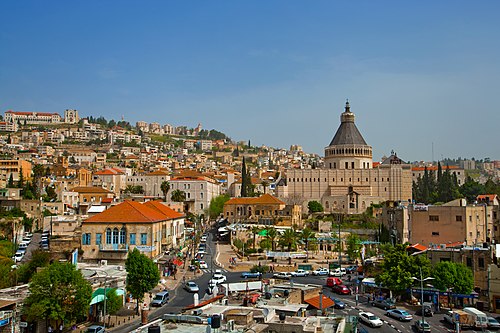
Photo: Israel_photo_gallery — CC BY-SA 2.0 (via Wikimedia Commons)

Photo: Jean Housen — CC BY-SA 3.0 (via Wikimedia Commons)

Photo: Eddie Gerald — CC BY-SA 3.0 igo (via Wikimedia Commons)

Photo: Godot13 — CC BY-SA 4.0 (via Wikimedia Commons)
In art


